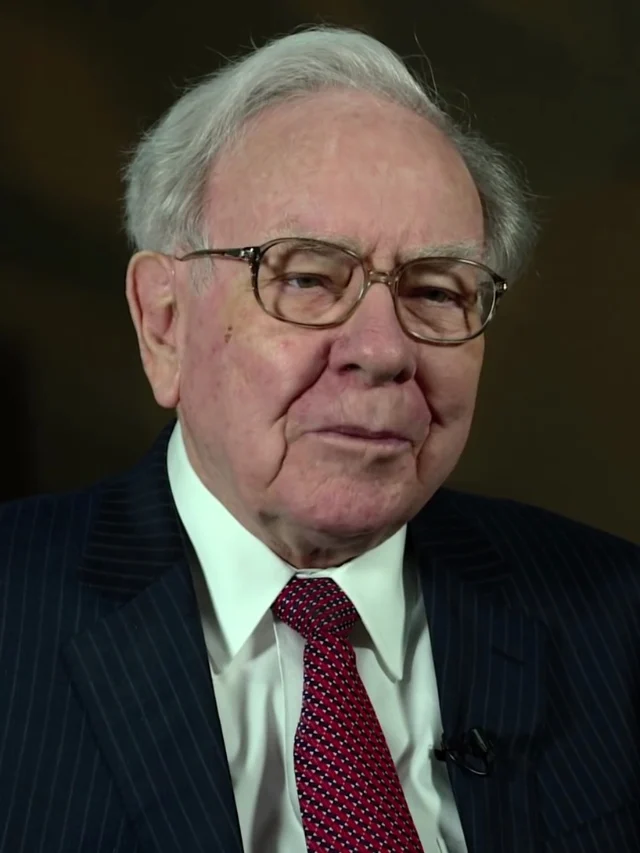
A boy from Omaha who bought his first stock at 11 and turned a textile mill called Berkshire Hathaway into a giant global conglomerate. Over 1965–2025, while he ran it, Berkshire’s market value per share grew 19.7% a year on average, almost double the S&P 500. This page sums up how he thinks, with the angles Forex and gold traders can use
BERKSHIRE HATHAWAY INC.3555 FARNAM STREET · OMAHA, NEBRASKA
To the Shareholders of Berkshire Hathaway Inc.:
Warren E. BuffettChairman Emeritus
2015 photo (public domain) / USA International Trade Administration · Wikimedia Commons
$1 at the end of 1964$1
→
held in Berkshire to the end of 2025≈$60,994
if held in the S&P 500 with dividends≈$462
COMPOUNDED ANNUAL GAIN19.7%Average annual growth in Berkshire’s market value per share, 1965–2025 (S&P 500 = 10.5%)
OVERALL GAIN 1964–20256,099,294%Cumulative gain in market value per share, vs 46,061% for the S&P 500
FIRST STOCK · 1942Age 11His age when he bought his first stock, Cities Service, at $38 a share
01
ProfileQuick facts
Full nameWarren Edward Buffett
NationalityAmerican
Born30 Aug 1930 · Omaha, Nebraska
EducationBS, University of Nebraska (1950) · MS in Economics, Columbia (1951), studying under Benjamin Graham
Main marketsUS stocks, whole businesses, insurance, government bonds
OrganisationsBuffett Partnership (1956–1969) · Berkshire Hathaway (in control since 1965 · CEO to the end of 2025 · Chairman Emeritus since Sep 2026)
Best known forBerkshire stock returns of 19.7% a year on average (1965–2025) · deals for See’s Candies, Coca-Cola, GEICO, Apple
Key ideasMargin of Safety · Circle of Competence · Mr. Market · holding great businesses for the long term
02
Early lifeEarly life: an Omaha kid in business from grade school
Buffett was born on 30 August 1930 in Omaha, Nebraska. His father, Howard Buffett, was a stockbroker and later a congressman. As a child he earned his own money selling soft drinks and chewing gum door to door, delivering newspapers and placing pinball machines in barber shops with a friend
He studied at Wharton for two years before finishing his bachelor’s degree at the University of Nebraska in 1950. Around then he read Benjamin Graham’s The Intelligent Investor, which completely changed how he thought about investing. After Harvard Business School rejected him, he went to study directly under Graham at Columbia, earning his master’s in 1951
After graduating he went back to work at his father’s brokerage in Omaha, then worked with Graham at Graham-Newman in New York from 1954 to 1956. When Graham closed the fund, Buffett returned to Omaha and set up his own investment partnership in 1956
LEDGER № 1 · CITIES SERVICE PFD · 1942His first stock: when would you have sold?
At 11, Buffett bought 3 preferred shares of Cities Service at $38 each, and 3 more for his sister Doris
Prices as Buffett recalled them in interviews, not real daily data
A turning point in his thinking
Buffett read The Intelligent Investor at 19 and has always called it the best book on investing he has ever read. Two ideas from it, Mr. Market and Margin of Safety, became the core of his investing for life
03
The letter shelfA 75-year bookshelf: key deals and events
Buffett’s investing life wasn’t all successes. Some deals he admitted were mistakes and wrote about in his shareholder letters. Tap each book spine to read the story of that year
1951 · Event
Knocking on GEICO’s door
As a Columbia student he took the train to GEICO’s office in Washington on a Saturday and talked insurance with an executive named Lorimer Davidson for hours. Later that year he put a large part of his own savings into the stock
04
Page one of every letterThe front-page table: 61 years of compounding
The first page of every Berkshire shareholder letter is the same table: the return on market value per share against the S&P 500 with dividends. Over 1965–2025 Berkshire grew 19.7% a year on average while the S&P 500 grew 10.5%. A gap of about 9% a year doesn’t look like much, but compounded over 61 years the total gain became 6,099,294% vs 46,061%
The path wasn’t smooth. There were 11 losing years: 1974 fell 48.7% and 2008 fell 31.8%. Berkshire beat the index in 40 of 61 years, and as the company grew, returns moved closer to the market: about 26% a year in the first 20 years, but about 11% over 2005–2025, close to the index
The figures in this calculator use the annual returns rounded to one decimal place in the letters, so totals may differ slightly from the official numbers
COMPOUNDING TABLE · BERKSHIRE vs S&P 500If you started investing in the year you choose, how much would your money grow?
Berkshire stock
S&P 500 with dividends
Losing years · years beating the index
Berkshire stock S&P 500 with dividends · bars beyond ±130% are clipped
See the table of all 61 years of annual returns
Year
Berkshire
S&P 500
BERKSHIRE-STYLE COST CONTROL · 1TRADERLow costs are a trader’s Margin of Safety
1TRADER is a partner (IB) and earns a commission when you open an account through our link · % is the share of IB commission returned to you · How to get rebates
05
Value labLab: can you handle Mr. Market?
Benjamin Graham described the market as a moody business partner called Mr. Market. Every day he offers to buy or sell your shares. On cheerful days he quotes prices far too high; on gloomy days, shockingly low. Buffett retold this in his 1987 letter and stressed that you never have to follow him. Try it: you value a made-up company at $100 a share, then deal with the prices he offers over 12 days
1TRADER is a partner (IB) and earns a commission when you open an account through our link · % is the share of IB commission returned to you · How to get rebates
06
Currencies & metalsBuffett on currencies and precious metals: what traders should know
Buffett isn’t a day trader, but Berkshire has held large currency and precious-metal positions. Each time he started from a fundamental reason, such as the US trade deficit or an imbalance between production and use, and held for years, not chasing daily price moves
So what Forex and gold traders can use isn’t copying his positions but his order of thinking: understand value first, allow for error, then decide on price. As for gold, he has always warned that it is an asset driven by fear rather than cash flow
EXHIBIT A · 2002–2005
Betting on a weaker dollar
$21.8 billionpeak position size, according to Forbes (Q1 2005)
Berkshire used currency forward contracts to hold the euro, Swiss franc, Australian dollar, yen, pound and other currencies, because Buffett worried about the US trade deficit. Forbes reported profits of about $297 million (2002), $825 million (2003) and $1.84 billion (2004), before losses began when the dollar recovered in 2005 (a $307 million loss in the first quarter)
EXHIBIT B · 1997–1998
Buying silver
129.7 millionounces: the total Berkshire announced (25 Jul 1997–12 Jan 1998)
The 1997 letter disclosed that Berkshire held 111.2 million ounces of silver, reasoning that consumption had exceeded production for years, so inventories kept falling. Berkshire later announced it had bought more, for a total of 129.7 million ounces, and he sold before the big rise in prices later on
EXHIBIT C · 2011
A 68-foot cube of gold
$9.6 trillionthe value of all the world’s gold at $1,750 an ounce, in the 2011 letter (published Feb 2012)
Buffett wrote that the world’s roughly 170,000 tonnes of gold would form a cube about 68 feet per side. The same money could buy all US cropland, 16 companies the size of Exxon Mobil, and leave about $1 trillion over. He pointed out that gold produces nothing, so its price depends on fear and the next buyer’s demand
1Value before price
Start from fundamentals such as interest rate differentials, inflation and the trade balance, then see whether the current price is cheap or expensive against that picture
2Allow for error
A trader’s Margin of Safety is a stop loss outside the normal swing range and a lot size small enough that being wrong doesn’t hurt badly
3Stay in your circle of competence
Choose one or two currency pairs, or gold, whose real drivers you understand, rather than trading everything that moves
4Use low leverage
Buffett and Munger always stressed that leverage can bankrupt even smart people. One big enough loss resets all the power of compounding
1TRADER REBATE BANKOMAHA-STYLE · No. 0001
PAY TO THE ORDER OFYou · a trader who controls costs
AMOUNTCash back up to 90% of the IB commission · every lot
1TRADER is a partner (IB) and earns a commission when you open an account through our link · % is the share of IB commission returned to you · How to get rebates
Berkshire’s currency positions were multi-year holdings to hedge dollar risk, not short-term speculation with high leverage. Practise on a demo account before using real money.
07
Investing philosophyBuffett’s principles: the 20-slot punch card
Buffett once said in a lecture that if everyone had a card with only 20 punches for all their investments in life, they would think much more carefully and only put big money in when truly confident. For traders, imagine this card is your trading quota for the month, and only punch it for setups that pass the full checklist
LIFETIME PUNCH CARDONE CARD · 20 PUNCHES
20 slots left
Tap a slot to punch it. Each slot stands for one decision to put money in
I understand what drives the price
The price is far enough below my valuation
I know where I’ll admit I’m wrong
The position size won’t badly damage my account
Rule No. 1Don’t lose money
Rule No. 1 is don’t lose money; Rule No. 2 is don’t forget Rule No. 1. What it really means is avoid permanent losses, not that prices can never go negative
Circle of CompetenceKnow your limits
The size of your circle of competence matters less than knowing where its edge is, and only putting money in within it
Margin of SafetyBuy with a margin of safety
Buy when the price is far enough below your valuation that even if you’re somewhat wrong, you won’t lose heavily
Mr. MarketThe market is your servant
Use the prices the market offers when they help you, but don’t let its mood drive your decisions
Fear & GreedBe fearful when others are greedy
His 1986 letter said to be fearful when others are greedy, and greedy only when others are fearful
The TideWhen the tide goes out
His 2001 letter said you only find out who’s swimming naked when the tide goes out. Hidden risks such as high leverage show up in a crisis
08
LessonsLessons for Forex and gold traders
Your checklist
0/4
01
Protect your capital before chasing profit
Buffett’s Rule No. 1 in trader’s terms: never let one trade badly damage your account. Keep the risk per trade to 1–2% of your account
No one reads the market right every time. Place your stop loss outside the normal swing range and reduce your lot size to match. That is a trader’s Margin of Safety
03
Trade only what you understand
Choose currency pairs or gold whose price drivers you know, such as central bank rates, instead of chasing every chart that moves
04
Use little leverage
Buffett built his wealth without heavy borrowing, using low-cost insurance float instead. High leverage makes you lose so fast you get no chance to recover
How old was Buffett when he bought his first stock?
In 1942 he bought 3 preferred shares of Cities Service at $38 each
What does Margin of Safety mean?
An idea from Benjamin Graham that Buffett used all his life
If Mr. Market offers a very low price out of panic while the business value hasn’t changed, what should you do?
The price the market offers is an opportunity, not an order
In 2002–2005, what did Berkshire bet on in the currency market?
Through currency forward contracts, with a peak position of about $21.8 billion
According to the 2025 letter, what was the average annual growth in Berkshire’s market value per share over 1965–2025?
Compared with 10.5% a year for the S&P 500 with dividends
0/5
10
Invest like BuffettFollow in Buffett’s footsteps: where to start
Buffett’s principles help traders when they are turned into real risk control. These tools on 1TRADER help you assess fundamentals, size your orders and watch out for days when the market is moody
REBATE · 1TRADER
Trade like a pro: control your costs
Open an account through 1TRADER and get cash back on every lot you trade, lowering your spread and commission costs over time.
Leveraged trading carries high risk. Study the broker’s terms and the risk disclosure before opening an account.
11
Further readingFurther reading
The Snowball: Warren Buffett and the Business of LifeAlice Schroeder · 2008A detailed biography written with Buffett’s cooperation in interviews
The Essays of Warren BuffettLawrence A. Cunningham (editor) · 1997Selections from the shareholder letters arranged by topic, easier than reading year by year
The Intelligent InvestorBenjamin Graham · 1949The book that changed Buffett’s thinking, the origin of Mr. Market and Margin of Safety
He has ranked among the world’s richest people for decades. Almost all his wealth is in Berkshire Hathaway shares, so the figure changes with the share price every day; check the latest data from Forbes or the Bloomberg Billionaires Index. He has given shares to charity every year since 2006
Does Buffett still run Berkshire Hathaway?
No. Greg Abel has been CEO since 1 January 2026, and on 18 September 2026 Buffett stepped down as chairman, succeeded by his son Howard Buffett. Buffett is now Chairman Emeritus and remains on the board. Earlier, in his November 2025 letter, he said he would go quiet and stop writing the annual letter, so the latest annual letter (February 2026) was written by Abel
Does Buffett trade Forex or gold?
He doesn’t trade day to day, but Berkshire held large currency positions in 2002–2005 betting the dollar would weaken, and bought silver in 1997–1998. As for gold, he has always criticised it as an unproductive asset
What is the Margin of Safety?
The gap between your estimated value and the price you pay, an idea from Benjamin Graham. The bigger the gap, the better you can withstand valuation errors or surprises. For traders, it compares to a stop loss and lot size that allow for error
Why does Buffett call Berkshire Hathaway a mistake?
He bought it because the stock was cheaper than its asset value, but the textile business was in decline and the money put into the mills earned poor returns. He said he would have done far better putting that money into an insurance business from the start. The lesson: a cheap stock isn’t always good value
Educational content, not investment advice. Return figures come from Berkshire Hathaway shareholder letters; deal figures come from news reports and books and some differ between sources. · risk disclosure · Forex glossary