
Watch the black-market exchange rate
He often said that at each border, the gap between the official and black-market exchange rates instantly shows how stressed a country’s economy is
Jim Rogers / The investor who travelled the world to find opportunities
Co-founder of the Quantum Fund with George Soros, he made about 4,200% in about 7 years, then “retired” at 37 to ride a motorcycle around the world. This page lets you try Quantum-style compounding, read black-market exchange rates the way he did at borders, and see why commodity prices move in long cycles
 JR
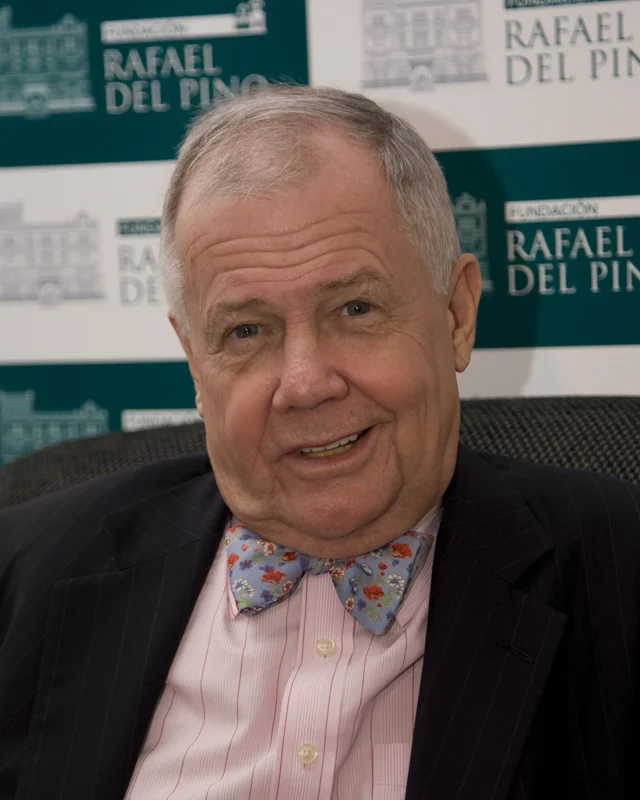
Photo: Wikimedia Commons (Madrid 2010) · passport page details are illustrative
Jim Rogers grew up in Demopolis, Alabama, and won scholarships to Yale and Oxford before starting on Wall Street. In 1970 he joined Arnhold and S. Bleichroeder, where he met George Soros
In 1973 the two left to set up their own fund, later known as the Quantum Fund. Rogers handled the in-depth research while Soros focused on trading. After about 7 outstanding years, he decided to leave the fund in 1980, at just 37
Born 19 Oct 1942 in Baltimore, Maryland, but grew up in the small town of Demopolis, Alabama
Jim Rogers’s thinkingI just wait until there is money lying in the corner, and all I have to do is go over and pick it up. I do nothing in the meantime
Paraphrased from his interview in Market Wizards (1989), not a direct quote
A return of about 4,200% means $1 became about $43, while the S&P turned $1 into about $1.47. Enter a starting amount in dollars, then slide through the years
This lab uses the same average compound rate every year, based on the commonly reported totals (about 4,200% and 47%). Actual year-by-year results varied, fees and taxes aren’t deducted, and the S&P figure excludes dividends
Lighten your cost load Open an XM account through 1TRADER and get up to 90% of the IB commission on every lot you trade
1TRADER is a partner (IB) and earns a commission when you open an account through our link · % is the share of IB commission returned to you · How to get rebates
After leaving Quantum he used travel as an economics classroom. Choose a trip to see how its distance compares with going around the world
0Around the world
Based on Earth’s circumference of about 40,075 km and an average Earth–Moon distance of about 384,400 km. Trip distances are the commonly reported figures
He often said that at each border, the gap between the official and black-market exchange rates instantly shows how stressed a country’s economy is
The harder the crossing, the more paperwork and the more officials asking for bribes, the higher the cost of doing business. That’s information you won’t find in financial statements
He believes investors should see countries, markets and people with their own eyes, not just read reports at their desks
At many borders, the rate people actually exchange at differs from the official rate. The wider the gap, the more pressure the authorities are trying to hold down. Choose an example or enter your own numbers
Countries A, B and C are made-up figures. The thresholds are rough guides for learning, not official indicators. Unofficial currency exchange is illegal in many countries; this lab is only for reading signals
1TRADER is a partner (IB) and earns a commission when you open an account through our link · % is the share of IB commission returned to you · How to get rebates
In Hot Commodities he explains that when prices stay low for a long time, nobody invests in new mines or production. When demand rises, supply can’t keep up, so prices rise for years. Try adjusting how long new production takes to come online
A simple model: demand grows 2.5% a year, producers invest more when prices are high, and old capacity declines 3% a year. All figures are made up to explain the mechanism, not a forecast for gold or any commodity
Stories about famous investors often get exaggerated in the retelling. We sort each by the weight of the evidence
The commonly reported figure, including on Wikipedia, is that the portfolio rose about 4,200% over 1973–1980, compared with about 47% for the S&P. Full annual statements haven’t been published for every year
Both the 1990–1992 motorcycle trip and the 1999–2002 car trip were recorded by Guinness World Records, as commonly reported
He set up his index and talked about a commodity bull market from the late 1990s, which was followed by soaring prices in the 2000s. But being right about direction isn’t the same as knowing the exact timing, and he has been wrong at times
He said in interviews that if you were smart in 1807 you moved to London, in 1907 to New York, and in 2007 to Asia. His family moved to Singapore in Dec 2007
He said this in Feb 2018 and has warned of crises many times. Such warnings have come both before real falls and during long continued rises, so they shouldn’t be used as timing signals
The opposite: he often says he isn’t a trader but a long-term investor who buys when nobody cares and waits for the fundamentals to change. Some positions he held for years
He has said in many interviews that he holds gold and silver as assets, not to trade, but that doesn’t mean he never adjusts his portfolio
Clear the trading-cost checkpoint. Open an XM account through 1TRADER and get up to 90% of the IB commission back
Visa stamp · Open account ↗1TRADER is a partner (IB) and earns a commission when you open an account through our link · % is the share of IB commission returned to you · How to get rebates
Cheap things can stay cheap for a long time, so he looks for both a low price and signs of positive change, such as a new policy or falling supply. Before buying gold or a currency pair, ask what will make the price turn
The gap between a currency’s official rate and the rate people really exchange at is a warning signal. If the gap keeps widening, the risk of devaluation rises
New mines and production take years, so commodity prices, including gold, move in long cycles. Big trends don’t end in a few weeks
An idea he often repeats: you don’t need to trade every day. Wait until the opportunity is clear before acting. Having no position is a position too
Question 1 / 5
They co-founded the Quantum Fund in 1973
About 4,200%, while the S&P rose about 47%
(130 − 100) ÷ 100 = 30%, a very wide gap that reflects stress on the currency
Opening new mines or production takes a long time, so prices rise or fall for longer than people expect
He moved to Singapore, believing the future lies in Asia
What you can use is seeing the big picture, finding cheap assets with a catalyst, and waiting patiently. Here are tools on 1TRADER that help
Open an account through 1TRADER and get cash back on every lot you trade, lowering your spread and commission costs over time.
How to get rebates, step by step →Leveraged trading carries high risk. Study the broker’s terms and the risk disclosure before opening an account.
An American investor born in 1942 who co-founded the Quantum Fund with George Soros in 1973. Over 1973–1980 the portfolio rose about 4,200%. He then travelled around the world and wrote several books. He now lives in Singapore
Besides loving adventure, he used travel to see each country’s economy with his own eyes, such as black-market exchange rates, how hard border crossings are and how people live, and used that in his investment decisions
If people are willing to exchange at a much worse rate than the official one, demand for foreign currency is higher than the authorities allow. It signals capital controls or a risk of a sharp currency fall
When prices are high, producers invest more, but new mines or production take years. By the time supply arrives, prices have already risen far, and when supply floods in, prices fall for a long time. So the cycles last years
Look at the big picture before trading, find assets that are cheap and have a catalyst, watch for signs of currency stress, use small position sizes if you hold long, and be willing to wait until the opportunity is clear
Educational content, not investment advice. Return figures are publicly reported figures. The labs use made-up data and models. · risk disclosure · Forex glossary