

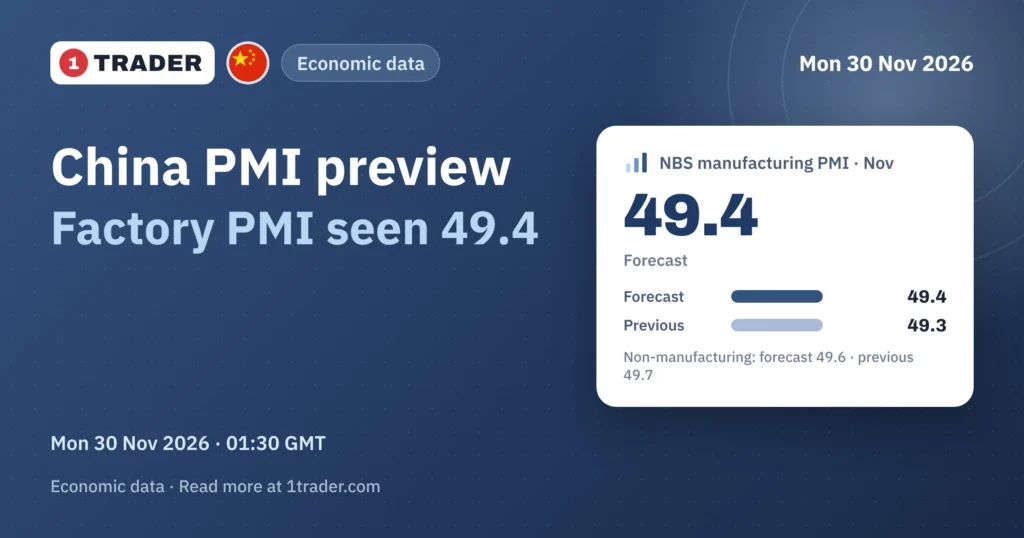
China’s National Bureau of Statistics (NBS) releases the official November PMIs at 01:30 GMT on Monday 30 Nov. Markets expect the manufacturing PMI at 49.4, up from 49.3 but still below 50 for a second month, and the non-manufacturing PMI at 49.6 from 49.7. Generally, this release moves the AUD, the yuan and commodity prices more than the US dollar or gold.
Created Sat 28 Nov 2026 · 23:47 GMT · Actual result will be updated here around 02:00 GMT
China Official NBS PMI, November 2026
Release Mon 30 Nov 2026 · 01:30 GMT
Quick take: China official PMI, November 2026
- 1NBS releases the data at 01:30 GMT on 30 Nov. A Reuters poll sees the manufacturing PMI at 49.4, a touch above 49.3 but still below the 50 line that separates expansion from contraction. Non-manufacturing is expected at 49.6 from 49.7.
- 2The main pressures are weak domestic demand and high energy costs linked to the war in the Middle East, even as exports hold up. In October the services index stood at 50.0 and construction at 48.0.
- 3Analysts do not expect large-scale stimulus before year-end; markets await policy signals from the December Central Economic Work Conference. Generally, a stronger PMI supports the AUD and the yuan, while the impact on gold and the US dollar is usually limited.
China PMI above / in line / below forecast: what it means
Manufacturing above 49.4, or back above 50
Generally supportive for the Australian dollar (AUD/USD), the New Zealand dollar and the yuan (USD/CNH may ease), as well as commodities such as copper and iron ore. The impact on the US dollar and gold is usually limited.
Manufacturing at 49.4 as expected, a second month of contraction
The figure is largely priced in, so the reaction is usually muted. Focus shifts to the non-manufacturing PMI, new orders and the RatingDog manufacturing PMI due on 1 Dec.
Manufacturing below 49.4, or services clearly weaker
Generally weighs on AUD/USD and the yuan, and may lift expectations of stimulus or LPR cuts (currently 3.00% / 3.50%). The impact on the US dollar and gold is usually limited.
What this release is and why markets care
China’s official PMI is a purchasing managers’ index compiled by the NBS with the China Federation of Logistics and Purchasing (CFLP), released around the last day of each month. Readings above 50 indicate expansion and below 50 contraction. It is the first monthly snapshot of China’s economy, the world’s largest buyer of raw materials, so markets use it to gauge commodity demand and the direction of the AUD and the yuan. Economic indicators guide →
Read the latest China data in China industrial profits for October and China LPR for November, see all policy rates on Central bank rates and the week’s events on the Economic calendar.
Timeline: China official PMI, November 2026
- October PMI: manufacturing 49.3, non-manufacturing 49.7
- China October industrial profits up 20.1%
- 1TRADER publishes this preview
- NBS releases November PMIs (manufacturing seen at 49.4)
- Actual result updated on this page
- RatingDog manufacturing PMI for November (forecast 51.5)
China PMI could move the AUD and yuan — get cashback on every lot

Rebate per lot · Standard Plus account

Rebate per lot · Standard account

Rebate per lot
1TRADER is a Partner (IB) of these brokers and earns a commission when you open an account through our links · % is the share of IB commission returned, not of your deposit · Rates as of Sep 2026 · Compare rebates across brokers
Learn to trade free with 1TRADER
Sources (4)
Risk warning: Trading forex, gold and CFDs carries a high level of risk and may result in the loss of all your capital. This article is analysis for educational purposes and is not investment advice.
Compiled by the 1TRADER editorial teamEditorial policy and sourcesFull risk disclosureReport an error
Read more
Related news
 Forex NewsPreview: Germany CPI Nov 2026 (30 Nov)Forecast 2.8%, Previous 2.8%
 Forex NewsPreview: Canada Q3 GDP 2026 (30 Nov)Forecast 1.3–1.5%, Previous 3.3%
 Forex NewsWeekly Forex Recap 23–27 Nov 2026: Gold +3%, Dollar Up 5th Week, NFP Next
 Forex NewsTokyo CPI Nov 2026: Core 2.9% In Line, Up from 2.6%; Core-Core Eases to 2.5%