
What Is Money Management?
Managing Risk and Calculating Lot Size
Money management means managing your capital so that no single loss hurts your account. Learn to measure distance in pips / points, calculate profit and loss, and use the lot size formula based on how much you are willing to lose, with EUR/USD and gold examples.
Quick summary before you read
- Money management means keeping the risk on each trade under control, for example no more than 1–5% of your account, so you can stay in the market for the long run
- Pip: on 4-decimal pairs 1 pip = 0.0001 · on gold/JPY pairs 1 pip = 0.01 · 1 pip = 10 points
- Profit/loss = pip value × lot size × number of pips · gold 1 lot ≈ $1 per pip, EUR/USD 1 lot = $10 per pip
- Lot size = amount you are willing to lose ÷ (SL distance in pips × pip value)
- If you don’t want to do the maths, use the Forex Calculator app
Previous lessons: EP1 Trends · EP2 Sideways markets · EP3 Trend reversals · EP4 Speed line · EP5 Demand & supply zones · EP6 FVG · EP7 Divergence · EP8 FIBO
What is money management, or risk management?
Whether you trade Forex, gold or crypto, good chart analysis or a good strategy is not enough on its own. Without proper capital and risk management, you could lose your whole account in a short time.
Understanding pips / points and how to calculate the right lot size makes your risk management effective, lowering the chance of blowing your account and improving your chance of steady profits. This lesson goes step by step, from measuring chart distance and working out profit and loss to calculating your lot size from the amount you are willing to lose.
Measuring chart distance (pips / points)
A pip, or price interest point, is the standard unit for measuring price changes. Usually 1 pip = 0.0001 on pairs with 4 decimals, such as EUR/USD and GBP/USD, but on gold or JPY pairs, which use 2 decimals, 1 pip = 0.01.
A point, which some brokers call a “pipette”, is a fraction of a pip: 1 pip = 10 points.
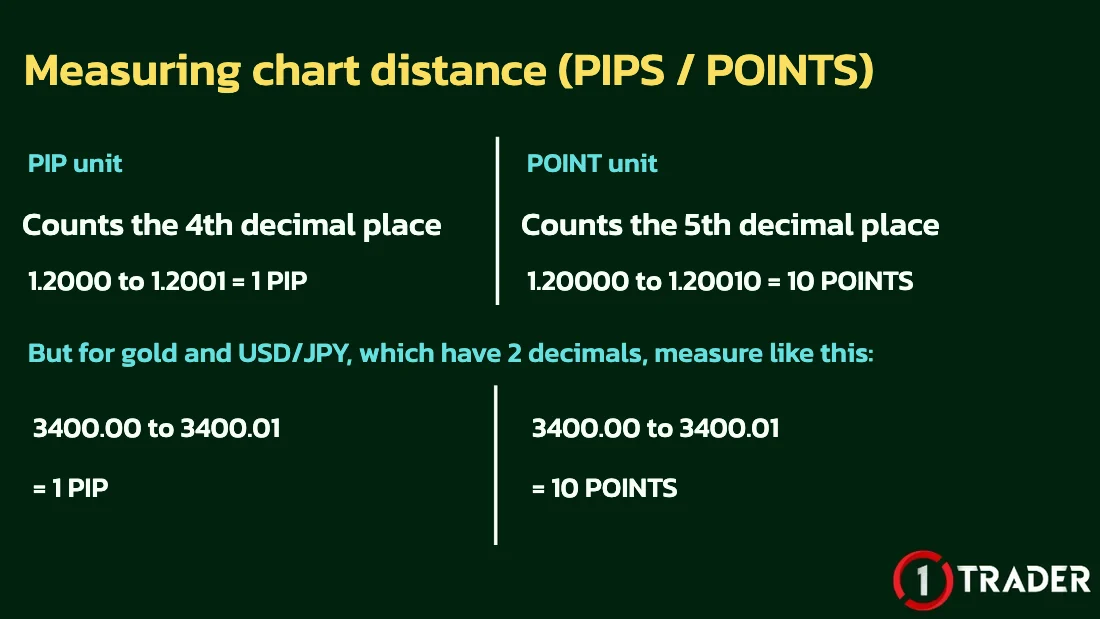
Examples of measuring chart distance
Watch the gold units: some brokers or traders count 1 gold pip = 0.10 (equal to 10 pips in this lesson). Your numbers stay correct as long as you use the same unit for both the SL distance and the pip value. This lesson uses 1 gold pip = 0.01 and a pip value of $1 per lot.
Calculating profit and loss
Every trader needs to understand how to calculate profit or loss in order to manage risk and evaluate trades. It depends on the pip value, the lot size and the number of pips price moves.
The pip value is the value of 1 pip (at 1 lot). Each pair has a different pip value: for example, a 1-pip move on EUR/USD is a $10 profit or loss, while a 1-pip move on gold is $1.
For pairs with USD first, such as USD/JPY and USD/CAD, the pip value changes with the price of that pair, so the figures are approximate.
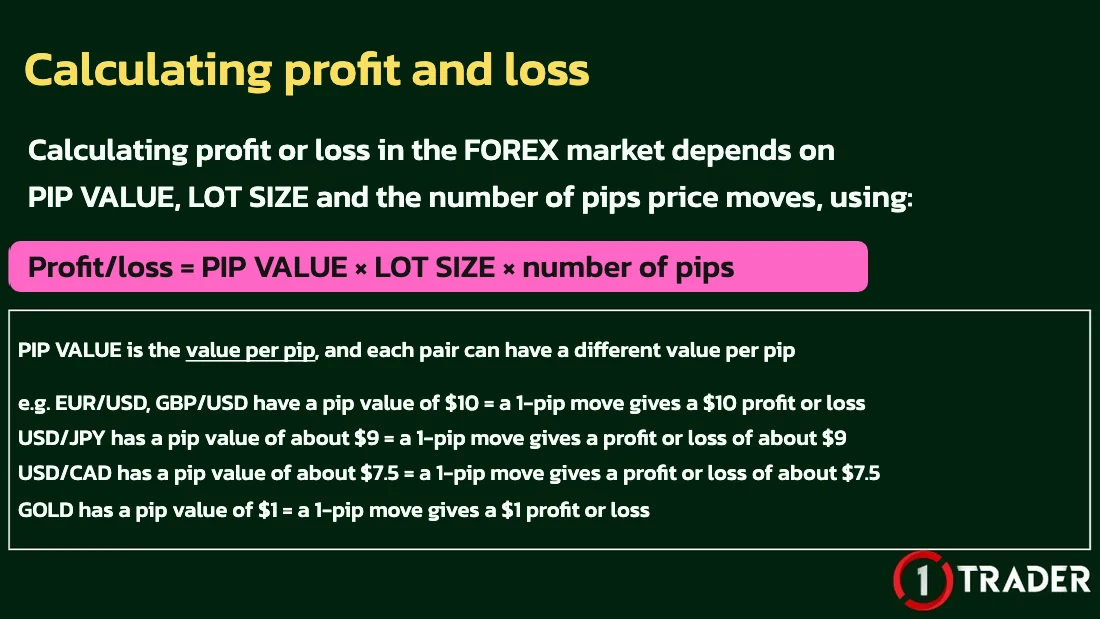
Examples of profit and loss calculations
Using the formula profit/loss = pip value × lot size × number of pips, let’s plug in 2 real orders.
BUY EUR/USD 1 lot
BUY at 1.1000 and close the order at 1.1050 (price rises 50 pips)
BUY gold 0.1 lot
BUY at 1800 and close the order at 1805 (price rises 500 pips)
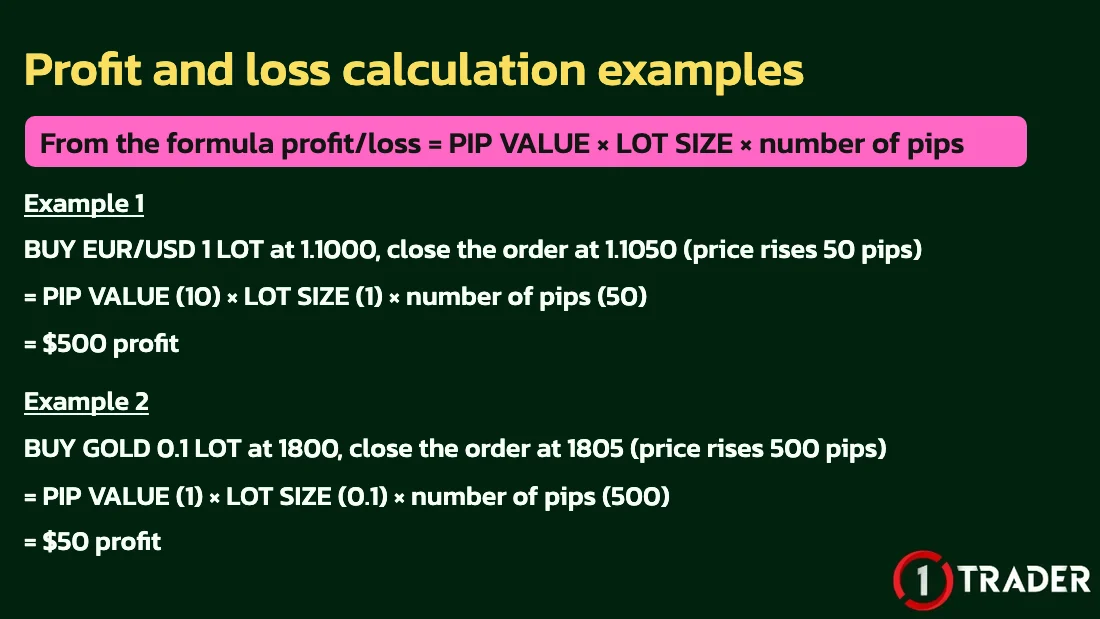
If price moves against you, the same formula gives a loss. In example 2, if gold falls from 1800 to 1795 (500 pips), you lose the same $50. That is why you must know in advance how much you lose if the SL is hit before every entry.
Managing risk with position size
A risk management method we use all the time is “risk management with position size”: setting the lot size of each trade to fit your capital and the risk you can accept, so losses stay within safe limits and you can trade steadily over the long run.
Start by setting the amount you are willing to lose, then check how many pips away your SL is, and work the lot size out backwards. Don’t pick a lot size first and then hope the SL isn’t hit.
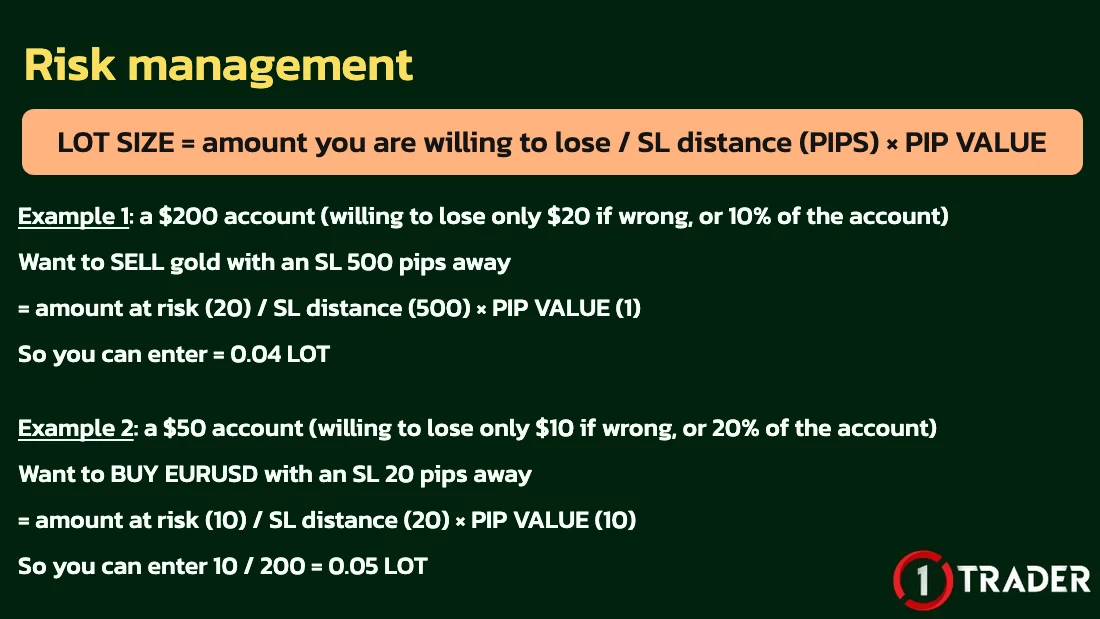
$200 account · SELL gold
You are willing to lose only $20 (10% of the account) and want to SELL gold with an SL 500 pips away
$50 account · BUY EUR/USD
You are willing to lose only $10 (20% of the account) and want to BUY EUR/USD with an SL 20 pips away
These examples use 10–20% risk to keep the numbers simple. In real trading, no more than 1–5% per trade is recommended, and if the result has extra decimals, round down to a lot size your broker supports (usually a minimum of 0.01) so you never lose more than planned.
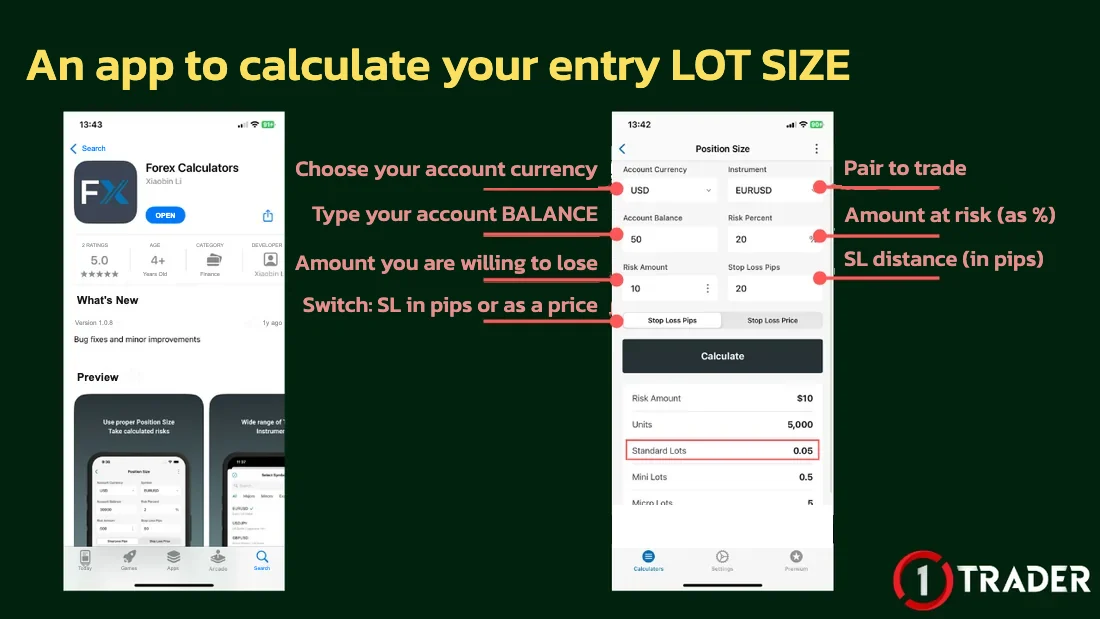
An app to calculate your entry lot size
If you don’t want to spend time calculating, use the Forex Calculator app (on iOS and Android) to work out your lot size. Choose the Position Size menu and fill in the following:
- Account Currency
- The currency of your account
- Instrument
- The pair or asset you want to trade
- Account Balance
- Your account balance
- Risk Percent
- How much you are willing to lose (as a %)
- Risk Amount
- How much you are willing to lose (as money) · fill in either the % or the amount
- Stop Loss Pips
- The SL distance in pips · or enter the SL price instead
Once everything is filled in, tap Calculate and the app works out the position size you can enter with.
Summary: money management formulas
| Topic | Formula / rule | Example | Result | When to use |
|---|---|---|---|---|
| Pip / Point | 1 pip = 10 points · gold/JPY 1 pip = 0.01 | GOLD 3400.00 → 3405.00 | 500 pips | Measuring SL and TP distance |
| Profit / loss | Pip value × lot × number of pips | EUR/USD 1 lot up 50 pips | +$500 | Know the outcome before entering |
| Lot Size | Amount at risk ÷ (SL pips × pip value) | Risk $20 · 500-pip SL on gold | 0.04 lot | Before every entry |
| Risk per trade | No more than 1–5% of the account | $1,000 account, 2% risk | $20 per trade | Always round the lot down |
The key to money management: set the amount you are willing to lose first, then let the SL distance decide the lot size, however good the chart looks. If no trade loses more than planned, your account can survive a losing streak and give your strategy time to make money.
FAQ about money management
What is money management?
Money management, or risk management, means managing your trading capital by keeping the risk on each trade at a level you can control, for example no more than 1–5% of your account, so losses don’t hurt your account as a whole and you can stay in the market for the long run.
What is the difference between a pip and a point?
A pip is the standard unit for measuring price changes. On 4-decimal pairs such as EUR/USD, 1 pip = 0.0001, while on gold and JPY pairs, which use 2 decimals, 1 pip = 0.01. A point (or pipette) is a fraction of a pip: 1 pip = 10 points.
How much is a 1-pip move on gold?
Using the units in this lesson, gold moving from 3400.00 to 3400.01 = 1 pip (10 points), and from 3400.00 to 3405.00 = 500 pips. One lot of gold has a pip value of about $1. Some brokers or traders count 1 gold pip = 0.10, so use the same unit for both the SL distance and the pip value.
How do you calculate Forex profit and loss?
Use the formula profit/loss = pip value × lot size × number of pips. For example, BUY EUR/USD 1 lot and price rises 50 pips = 10 × 1 × 50 = a $500 profit, or BUY gold 0.1 lot and price rises 500 pips = 1 × 0.1 × 500 = a $50 profit.
How do you calculate the right lot size?
Use the formula lot size = amount you are willing to lose ÷ (SL distance in pips × pip value). For example, risking $20 on a gold SELL with a 500-pip SL = 20 ÷ (500 × 1) = 0.04 lot. If the SL is hit, you lose only $20.
What percentage of your account should you risk per trade?
A common guideline is no more than 1–5% of your account per trade. The lower the percentage, the better your account can survive a losing streak. The 10–20% used in this lesson’s examples is only there to keep the numbers simple.
Is there an app that calculates lot size?
Yes, for example the Forex Calculator app (iOS and Android). In the Position Size menu, enter the currency, pair, balance, risk as a % or an amount, and the SL distance, then tap Calculate and the app works out the lot size automatically.
Read EP8 again Next lesson · EP10 What Is Backtesting? Free Backtest Sites: FXReplay and FastBull Why backtest · FXReplay step by step · FastBull Bar Replay · free-plan limits
Read EP10 →
See all lessons in the free Forex and gold trading course
Risk warning: Trading Forex, gold and CFDs carries a high level of risk and you may lose money. 1TRADER provides information and education to support your own decisions only. The figures in the examples are for illustration; actual pip values depend on the broker, account type and current price. Read the full risk disclosure.