

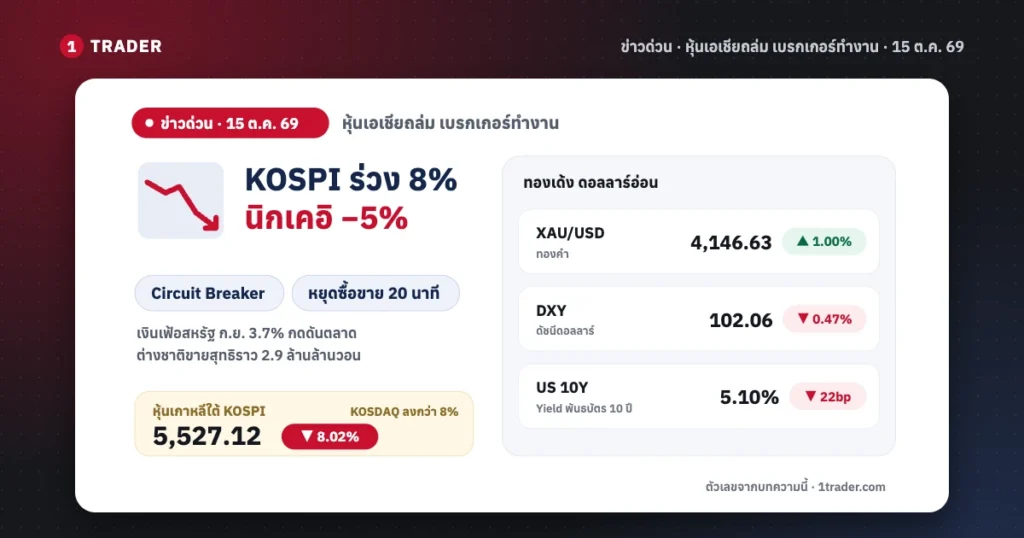
Breaking: Asian stocks tumbled on Thursday. South Korea’s KOSPI and KOSDAQ plunged more than 8%, triggering circuit breakers that halted trading for 20 minutes, and Japan’s Nikkei fell about 5%, while gold (XAUUSD) rebounded about 1% and the dollar (DXY) weakened after hot US inflation and worries over AI investment debt.
Updated Thu 15 Oct 2026 · 05:15 GMT · Prices in this article as of around 05:10 GMT (intraday, before Asian markets close). Prices can change quickly.
First-stage circuit breakers were triggered on both the KOSDAQ (03:23 GMT) and the KOSPI (03:38 GMT), the first time both have been hit on the same day since 29 Jul.
Key points
- 1South Korea’s KOSPI fell 8.02% to 5,527.12 and the KOSDAQ dropped more than 8%, halting trading for 20 minutes. Foreign investors were net sellers of about 2.9 trillion won, while Japan’s Nikkei fell about 5%.
- 2The trigger was US September inflation at 3.7%, higher than the previous month, which stoked fears the Fed will keep hiking, combined with worries about the debt behind AI infrastructure spending and whether it will pay off. Chip stocks were sold off.
- 3Currency and bond markets moved the other way: gold rebounded about 1% to around $4,147, the dollar fell 0.47%, the yen strengthened, the US 10-year Treasury yield eased to around 5.10%, and the won weakened.
Assets affected
KOSPI from Reuters/Seoul Economic Daily at the time of the circuit breaker · Nikkei, 10-year yield and Brent crude from AP · Gold, dollar and yen from Trading Economics as of around 05:10 GMT · USD/KRW from Reuters (onshore market) · % vs previous close · 10-year yield vs yesterday’s high of 5.32% · ▲ USD/KRW = weaker won
KOSPI and KOSDAQ plunge over 8%, trading halted
South Korea’s stock market faced heavy selling on Thursday, 15 Oct. According to Reuters, the KOSPI fell about 8%, or 480.76 points, to 5,528.05 at 03:38 GMT, triggering a first-stage circuit breaker that halted trading for 20 minutes. Shortly before that, the KOSDAQ had dropped 8.01%, triggering its own circuit breaker at 03:23 GMT. Korea JoongAng Daily said it was the first time since 29 Jul that both markets were halted on the same day.
Seoul Economic Daily reported that when the circuit breaker hit, the KOSPI stood at 5,527.12, down 8.02% from the previous close of 6,008.81. Heavyweights fell sharply: Samsung Electronics dropped about 9.7–9.9% and SK hynix lost more than 11%. Foreign investors were net sellers of about 2.9 trillion won (about $2 billion). The KOSPI fell for a 7th straight day, its longest losing streak since Sep 2024. In Japan, AP reported that the Nikkei 225 fell about 5% to 64,334.68, and Taiwan’s index dropped 3.4%.
Hot US inflation + worries over AI investment debt
The selling followed on from Wall Street overnight. US CPI for September rose to 3.7% y/y from 3.4% the month before, raising fears that the Fed will need to keep hiking. The Nasdaq closed 1.9% lower and the Philadelphia Semiconductor Index fell 4.3%, according to AP and Reuters. Seoul Economic Daily also noted market worries about the debt used to fund AI infrastructure, amid growing questions over whether it will generate enough revenue.
Currency and bond markets told a different story. The US 10-year yield eased to around 5.10% after jumping above 5.32% yesterday (AP). The dollar fell about 0.47% to around 102.06, and the yen (USD/JPY) strengthened to 157.69. Gold rebounded about 1% to around $4,147 an ounce, according to Trading Economics and FXStreet, which said the support came from lower yields and a softer dollar. Meanwhile, the San Francisco Fed’s Mary Daly said rates may need to rise again but there is no need to rush in October. The won weakened about 0.44% to 1,348.2 per dollar. See the latest central bank rates on the central bank rates page
What to watch
What to watch: where Asian markets close today, and whether the selling spreads to Europe and the US later today. The US releases retail sales and the producer price index (PPI) today, and on Friday Fed Chair Kevin Warsh is scheduled to speak at the IMF/World Bank meetings in Bangkok, which should show how the Fed views 3.7% inflation. If stocks keep falling, gold and the yen could get safe-haven support, but if today’s data come in hot again, yields and the dollar could rebound and pressure gold. See all release times on the economic calendar and this morning’s market overview in Forex News 15 Oct.
Asian stocks crash and markets swing: get cash back on every lot

Rebate per lot · Standard Plus account

Rebate per lot · Standard account

Rebate per lot
1TRADER is a Partner (IB) of these brokers and receives a commission when you open an account via our links · % is the share of the IB commission returned to you, not of your deposit · Rates as of Sep 2026 · Compare rebates for all brokers
Read more
Learn to trade for free with 1TRADER
Sources (10)
- Reuters (via Investing.com) – KOSPI triggers circuit breaker (15 Oct)
- Seoul Economic Daily – Korea halts trading as KOSPI, KOSDAQ plunge 8% (15 Oct)
- Korea JoongAng Daily – Circuit breakers hit Kospi, Kosdaq (15 Oct)
- AP – Tech sell-off drags Asian stocks lower (15 Oct)
- FXStreet – Gold rallies above $4,150 (15 Oct)
- investingLive – Asia-Pacific market news (15 Oct)
- Trading Economics – Gold
- Trading Economics – DXY
- Trading Economics – JPY
- Trading Economics – KOSPI
Risk warning: Trading forex, gold and CFDs is high risk and you may lose all of your capital. This news summary is for educational purposes only and is not investment advice. Prices in this article may have changed by the time you read it.
Compiled by the 1TRADER editorial teamEditorial policy and sourcesFull risk disclosureReport an error
Read more
Related news
 Forex NewsBreaking: Brazilian Real Plunges 12% as Lula Wins, Stocks Halted
 Forex NewsGold Price Today 23 Oct 2026: XAUUSD Near $4,018, Close to $4,000
 Forex NewsWeekly Forex Recap 19–23 Oct 2026: Gold Drops 4% to $4,000, Oil Surges
 Forex NewsForex News 26 Oct 2026: Gold Drops Below $4,000, Oil Climbs Before Fed