
What Is a Trading Session? Forex Market Hours and the Best Times to Trade
The market is open 24 hours, but not every hour is worth trading. Learn the GMT times of the 4 main sessions, the overlap with the most liquidity and when gold moves most
Quick summary before you read
- The Forex market is open 24 hours, 5 days a week, but it is only busy while the major markets are open; these periods are called trading sessions
- There are 4 sessions: Sydney · Tokyo · London · New York (in GMT they shift by 1 hour with the seasons, because those countries use daylight saving time)
- The best window is the London–New York overlap, about 12:00–16:00 GMT (13:00–17:00 in winter), with high liquidity and tight spreads
- Gold moves most in the same window, while the daily rollover around 21:00–22:00 GMT has wide spreads and is best avoided
What is a trading session?
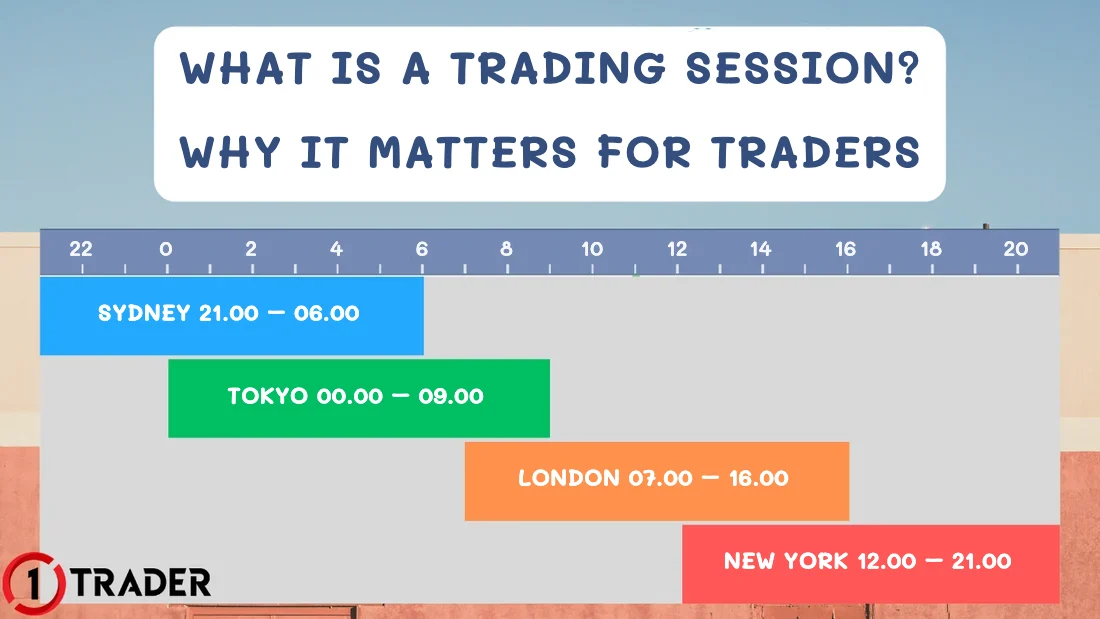
The Forex market is open 24 hours a day, 5 days a week because there is no single central exchange. Trading runs through banks and financial institutions around the world, which open one after another across time zones. You can trade at almost any time, but the market is not equally busy all day.
- Week opens
- Sunday around 21:00 (22:00 in winter), when the Sydney market opens
- Week closes
- Friday around 21:00 (22:00 in winter), which is 17:00 New York time
- Overlap
- When 2 sessions are open at once: the most traders and the strongest moves
- Why it matters
- Knowing when charts move and when they are quiet lets you match your strategy to the market’s rhythm
- The biggest centre
- According to the 2025 BIS survey, global FX turnover is about $9.6 trillion a day; London is the largest centre, followed by New York
- GMT
- GMT has no daylight saving, but Europe, the US and Australia do, so session times in GMT shift with the seasons
The 4 main sessions in GMT
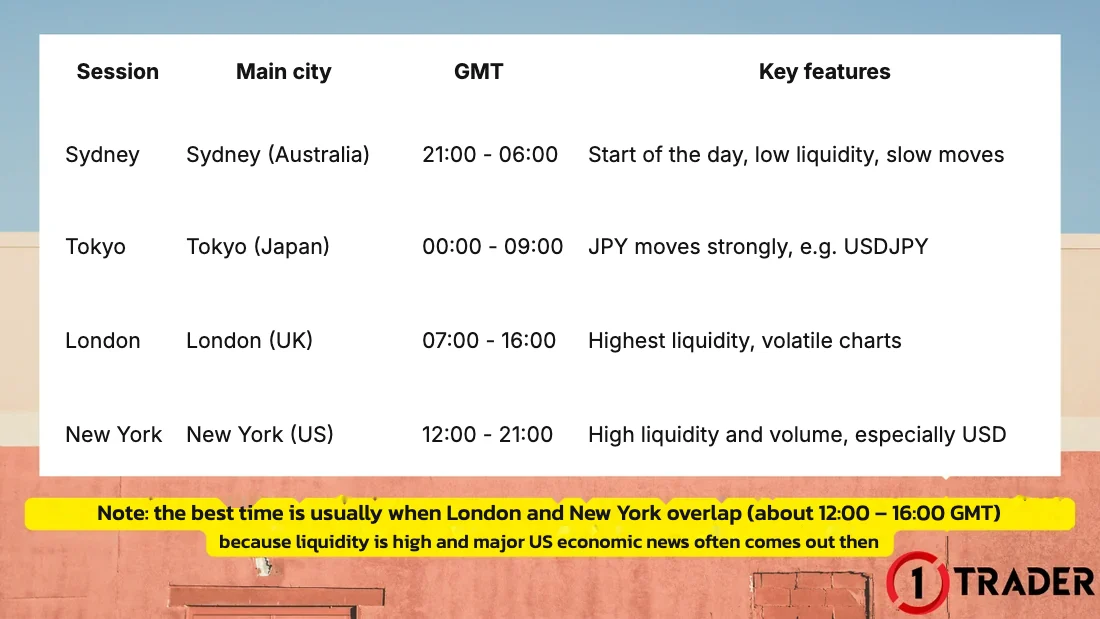
The market has just started a new day: few traders, slow charts and fairly wide spreads. The weekly open often gaps away from the previous week’s close.
The yen (JPY) moves more because Japan is Asia’s major financial centre. Japan has no daylight saving, so the times stay the same all year. Late in the Tokyo session, as London approaches, some pairs start to pick up.
European banks and funds enter the market, giving the highest liquidity in the world. In the first 2 hours (07:00–09:00) and around European news, charts often move hard and break the Asian range.
The US market opens with major economic news such as Non-Farm Payrolls, CPI, GDP and FOMC. After London closes (after 16:00, or 17:00 in winter), liquidity gradually fades until the daily close.
Check the season: the main times (Sydney 21:00–06:00, Tokyo 00:00–09:00, London 07:00–16:00, New York 12:00–21:00) apply only during daylight saving (roughly late March to early November). In winter, Sydney, London and New York move 1 hour later in GMT, while Tokyo stays the same. Sydney doesn’t open a new week every day; it is simply the first session of each trading day.
Session overlaps
When 2 markets are open at once, traders from both regions are in the market together, so volume is high, spreads are tight and price moves clearly. That makes overlaps the favourite time for short-term traders.
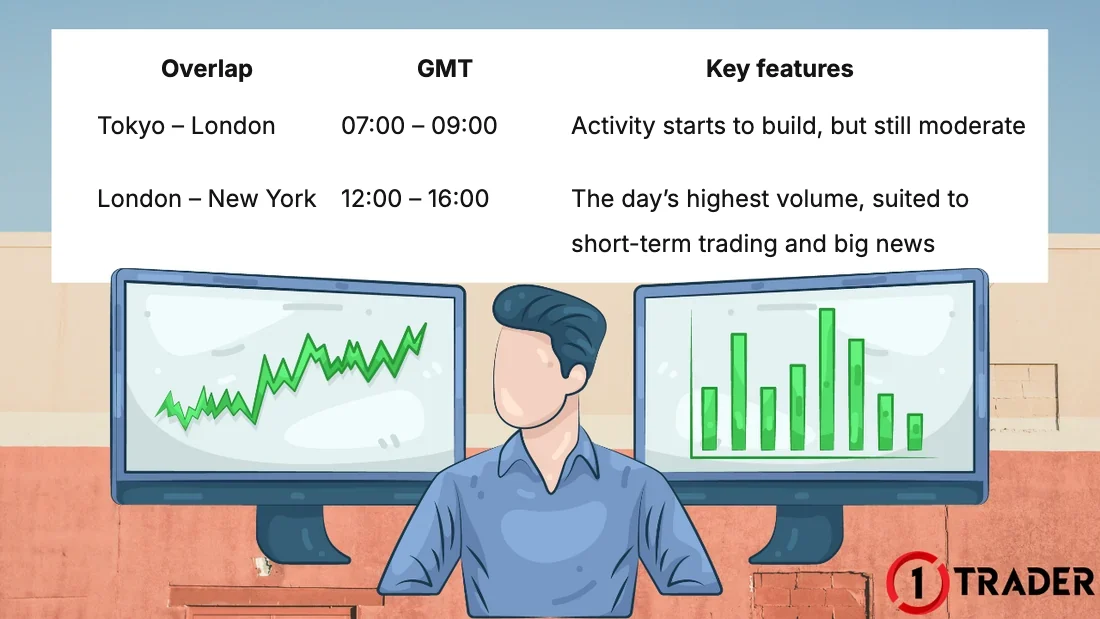
Overlaps bring high opportunity and high risk at the same time: charts move fast and break support and resistance easily. Reduce your lot size or allow a wider SL as in EP9 Money management, and check news times in EP21 Forex Factory every day.
Summer vs winter time: what changes
The UK, the US and Australia change their clocks with the seasons (daylight saving time), but GMT does not change. Market opening and closing times in GMT therefore shift by 1 hour twice a year.
Daylight saving time
Main US news at 12:30 · daily rollover around 21:00
Standard time
Main US news at 13:30 · daily rollover around 22:00
2026: the US uses daylight saving from 8 Mar to 1 Nov, the UK from 29 Mar to 25 Oct. In the 1–3 weeks when the two countries’ clocks change on different dates, the London–New York overlap is 1 hour longer or shorter than usual, so check the times in a news calendar or on the Forex market hours page.
When is the best time to trade?
Build sessions into your strategy: the narrow Asian session often forms a sideways range that breaks when London opens, while the overlap suits trend trading, for example with the EMA (EP24) or pivot points (EP23) to frame daily support and resistance.
Cautions about trading hours
Summary: trading sessions (GMT)
| Session | Summer (DST) | Winter | Key pairs | Character |
|---|---|---|---|---|
| Sydney | 21:00–06:00 | 22:00–07:00 | AUD, NZD | Start of the day, low liquidity, slow charts |
| Tokyo | 00:00–09:00 | 00:00–09:00 | JPY | Yen moves strongly, charts range |
| London | 07:00–16:00 | 08:00–17:00 | EUR, GBP, XAUUSD | Highest liquidity, breaks the Asian range |
| New York | 12:00–21:00 | 13:00–22:00 | USD, XAUUSD | Big news, 4-hour overlap with London |
Trading sessions help you understand “the market’s rhythm”: when to trade and when to stay out. The Forex market may be open 24 hours, but not every hour is worth trading. Pick the window that fits your strategy and your free time, and trade it consistently.
FAQ about trading sessions
What is a trading session?
A trading session is the period when one of the world’s main financial centres is open. There are 4 main sessions: Sydney, Tokyo, London and New York. Although the Forex market is open 24 hours, 5 days a week, liquidity and volatility are high only while the major markets are open.
What time does the Forex market open in GMT?
The Forex market opens on Sunday at about 21:00 GMT and closes on Friday at about 21:00 GMT during daylight saving (roughly March to October). In winter (roughly November to March) both move to about 22:00 GMT. Exact times depend on your broker.
Which session is best to trade?
The London–New York overlap, about 12:00–16:00 GMT in summer or 13:00–17:00 GMT in winter, because it has the highest volume of the day, tight spreads and frequent US economic news. It is also the most volatile period.
When is the best time to trade gold?
Gold (XAUUSD) usually moves most at the London open and during the London–New York overlap, about 12:00–16:00 GMT (winter 13:00–17:00), especially at US news time, 12:30 GMT (winter 13:30). In the Asian session gold usually trades in a narrower range.
Why are session times different in summer and winter?
Because the UK, the US and Australia use daylight saving time, while GMT does not change. When those countries change their clocks, market opening and closing times in GMT move by 1 hour. Tokyo does not change its clocks.
When should I avoid trading?
Avoid low-liquidity periods: the daily rollover around 21:00–22:00 GMT when spreads often widen, the weekly open when price may gap, late Friday near the market close, and major holidays such as Christmas or New Year.
Why doesn’t the time on my MT4 chart match GMT?
MT4 and MT5 show the broker’s server time, which is usually set to GMT+2 or GMT+3, so it runs 2–3 hours ahead of GMT. Convert server time to GMT before reading which session a candle belongs to.
Read EP24 again Next lesson · EP26 The Truth About Support and Resistance: Why Price Breaks or Bounces and How to Find Entries Layers of support/resistance · divergence · SL/TP with multiple targets
Read EP26 →
See all lessons in the free Forex and gold trading course
Risk warning: Trading Forex, gold and CFDs carries a high level of risk and you may lose money. High-liquidity periods are also highly volatile. 1TRADER provides information and education to support your own decisions only. Past results do not guarantee future results. Read the full risk disclosure.