
How to Choose a Forex Broker as a Beginner: 5 Things to Check
License · spreads and commissions · platform · deposits and withdrawals · customer support. Check them all before you deposit real money, plus how to verify a license yourself.
Quick summary before you read
- Check the license before anything else, and find out which company in the group holds your account, because protection is tied to the legal entity, not the brand name
- Compare the total cost per lot = spread + commission, then look at swap and deposit/withdrawal fees too
- Make a small test withdrawal early on, and contact customer support before you deposit real money
- Be wary of anyone who asks you to transfer money to a personal account or guarantees profits
What is a Forex broker, and why choose carefully?
The foreign exchange market, or Forex (Foreign Exchange), is the largest and most liquid financial market in the world. Retail traders reach it through a broker, which opens your trading account, provides the platform and handles your orders in currencies, gold and CFDs.
Before opening an account, check these 5 main things, starting with the most important.
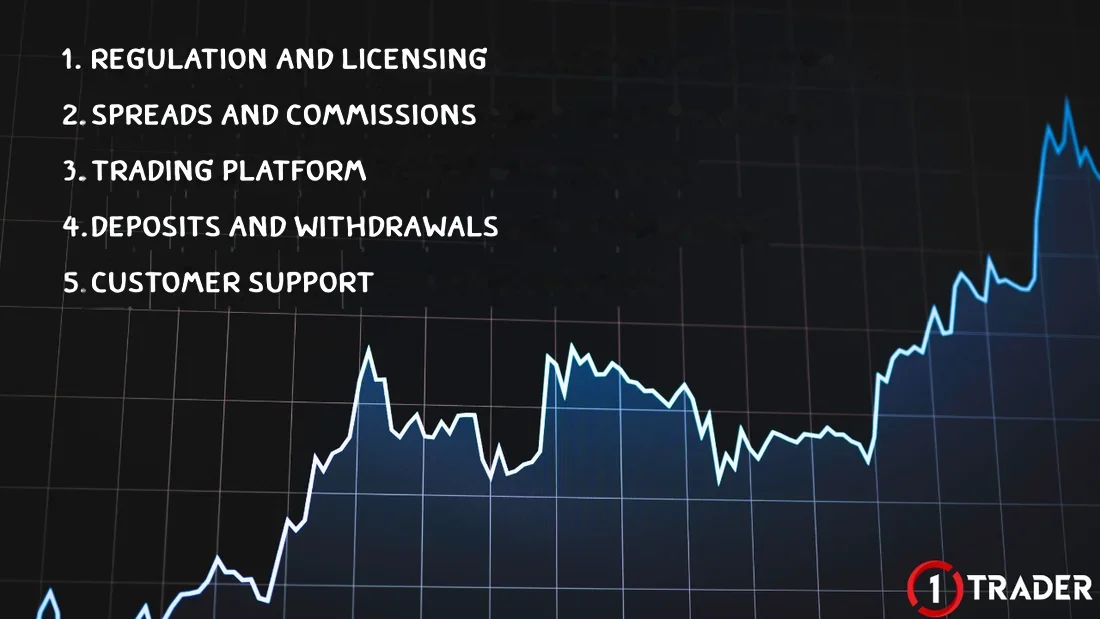
1. Regulation and licensing
This is the most important point. A trustworthy broker must be supervised by a recognised financial regulator that enforces minimum capital, segregated client money and regular reporting. Examples of strict regulators:
Retail client money is covered by the FSCS up to £85,000 per person per firm if the firm fails and cannot return it.
Follows EU rules, with an Investor Compensation Fund covering up to €20,000 per client.
Requires segregated client money and has limited retail leverage since 29 March 2021.
Retail clients under these 3 regulators get similar protections: leverage limits (30:1 on major pairs, 20:1 on gold), an automatic close-out when your equity falls to 50% of the required margin, and negative balance protection, so you cannot lose more than the money in your account.
Compensation schemes such as the FSCS and ICF only pay out when a firm goes bust and cannot return client money. They do not cover trading losses.
A license belongs to the “company”, not the “brand”
Large brokers usually run several group companies, each licensed in a different country. Most international clients are onboarded with an offshore company licensed by another regulator, such as Seychelles, Mauritius or South Africa, whose protections are not the same as the FCA’s or CySEC’s and which usually allows much higher leverage. Seeing an FCA logo on the website does not mean your account gets FCA-level protection.
Check your local rules: some countries do not license retail Forex brokers at all, or restrict trading with offshore brokers. Check with your own financial regulator what is allowed where you live. Never transfer money to a middleman or a personal account that offers to hold or trade funds for you, and report suspected scams to your local regulator.
2. Spreads and commissions
You pay trading costs every time you open an order, and the more often you trade, the more they eat into long-term profit. The spread is the difference between the buy price (Ask) and the sell price (Bid). A BUY opens at the Ask but closes at the Bid, so every order starts negative by the spread.
Standard account
Raw spread account
These numbers only illustrate the method; real costs differ between brokers and over time. Besides spreads and commissions, also look at swap (the overnight holding cost), deposit and withdrawal fees, and any inactivity fee.
Spreads often widen around big news such as NFP, CPI and FOMC (check news times on Forex Factory, EP21) and at the server’s daily rollover. A demo account gives a rough idea of the spread, but demo prices may not match a live account when the market is volatile, so test with a small live account first.
3. Trading platform
The platform is the tool you use to analyse charts and send orders. It should be stable, easy to use and fully equipped.
- MetaTrader 4 (MT4)
- Widely used, with plenty of free indicators and EAs, such as the indicator in EP16
- MetaTrader 5 (MT5)
- Newer, with more timeframes, EA support and more asset types
- cTrader
- Focuses on price transparency and fast order execution
- Mobile app
- Must let you open, close and edit SL/TP anywhere
- Execution speed
- Check slippage during big news: how far the fill is from the price you clicked
- Use with TradingView
- Analyse on TradingView (EP15) and place orders in MT4/MT5
Gold prices differ slightly between brokers. Before trading live, check the XAUUSD contract size under Symbol > Specification so you calculate your lot correctly. See how in the EP28 trading journal.
4. Deposits and withdrawals
A good broker lets you withdraw as easily as you deposit, because this is about access to your own money.
Most brokers send withdrawals back to the method you deposited with, under anti-money-laundering rules. Also beware of deposit bonuses that require you to trade a set number of lots before you can withdraw. Read all the terms before accepting one.
5. Customer support and red flags
When an order gets stuck, a withdrawal doesn’t arrive or the platform goes down, good customer support solves the problem quickly.
- Contact channels
- Live chat, phone and email; there should be several options
- Your language
- Staff who speak your language make problems easier to resolve clearly
- Opening hours
- At least 24 hours, 5 days a week, in line with market hours. See Trading sessions (EP25)
- Contact them before depositing
- Ask about withdrawal fees and which company will hold your account, and see how directly and quickly they answer
- Read real user reviews
- Look for repeated problems, especially with withdrawals, rather than the overall score
- Disputes
- Know which regulator to complain to, based on the license of the company that holds your account
Summary table: Forex broker checklist
| Factor | What to check | Example | Red flag |
|---|---|---|---|
| License | The company holding your account, and the regulator’s register | FCA · CySEC · ASIC | Not found, or the domain doesn’t match |
| Spread + commission | Total cost per lot, and swap | Standard $25 vs Raw $12 (hypothetical) | Costs not clearly disclosed |
| Platform | Stability, mobile app, slippage | MT4 · MT5 · cTrader | An unknown platform |
| Deposits and withdrawals | Methods, timing, fees, KYC | Test a small withdrawal first | Asked to pay a personal account |
| Customer support | Channels, your language, 24/5 | Ask questions before depositing | Guaranteed profits, pressure to deposit more |
A good broker is a safe “home”; then you can focus on analysing the market
Choosing a broker is the first and most important decision in trading. Don’t decide in a hurry because of ads or bonuses. Take the time to verify the license yourself, compare the total cost, try the platform and test a withdrawal. Once you are confident, focus on analysing the market and developing your trading plan, starting with risk management in EP9.
Frequently asked questions about choosing a broker
What is a Forex broker?
A Forex broker is an intermediary company that provides your trading account and platform, such as MT4 or MT5, and executes your orders in currencies, gold and CFDs. Brokers earn from spreads, commissions and swap.
What should I check first when choosing a Forex broker?
Always check the license and regulator first, then confirm which legal entity your account will be with. After that, compare costs (spread, commission, swap), the platform, deposits and withdrawals, and customer support.
How do I verify a broker’s license?
Find the company name and license number in the broker’s website footer, then search the regulator’s official website, such as the FCA Register, CySEC’s list of firms or the ASIC Professional Register. The company name, license number and website domain must all match.
If a broker has an FCA license, does my account get FCA protection?
Not always. A license belongs to a legal entity, and one broker group may have several companies in different countries. International clients are often onboarded with a separate offshore company licensed by a different regulator. Check the company name in your Client Agreement to see which one it is.
What is the difference between a Standard and a Raw spread account?
A Standard account has no commission but wider spreads, while a Raw or Zero spread account has very tight spreads but charges a commission per lot. Compare the total cost per lot = spread + round-turn commission.
Does my own country’s regulator protect an account with an offshore broker?
Usually not. If your account is with an offshore company, your local regulator generally cannot step in, and any dispute goes to the regulator named on that company’s license. Check with your local regulator whether trading with offshore brokers is allowed where you live.
What signs suggest a broker or someone offering an investment may not be safe?
Guaranteed profits, asking you to pay a personal account instead of the broker’s own channels, offers to trade or manage your account for you, bonuses with complicated withdrawal conditions, pressure to deposit more, and a license number that can’t be found or a domain that doesn’t match the register.
Read EP28 again Next lesson · EP30 Which Timeframe Is Best to Trade? Match It to Your Trading Style Timeframe pairs for Position · Swing · Day Trade · Scalping
Read EP30 →
See all lessons in the free Forex and gold trading course
Risk warning: Trading leveraged Forex, gold and CFDs carries a high level of risk and you may lose all the money you invest. Regulator information is as of October 2026 and may change, so check the official websites before you decide. 1TRADER is a partner (IB) of some brokers and provides information to support your own decisions only. Read the full risk disclosure.