
Which Timeframe Is Best? Match It to Your Trading Style
Position · Swing · Day Trade · Scalping: which timeframe each style uses for the trend and which for the entry, and why there is no single answer for everyone.
Quick summary before you read
- No timeframe is best for everyone. A good timeframe fits your trading style, the time you have and the stress you can handle
- Position W/MN + D1 · Swing D1 + H4 · Day Trade H1 + M5 · Scalping M5 + M1
- The smaller the timeframe, the more noise and the higher the spread cost relative to profit. The bigger the timeframe, the wider the stop loss and the more patience you need
- Use a higher timeframe for the trend and a lower one for the entry, about 4–6 times apart, and stick to the same pair consistently
What is a timeframe, and why is none the best?
Whether you trade stocks, Forex, gold or crypto, the question beginners (and even experienced traders) keep coming back to is “Which timeframe is best to trade?” The short, perhaps disappointing answer is that no single timeframe is best for everyone.
The right timeframe depends on 3 things: your trading style, your personality and the time you can really give the market. The smaller the timeframe, the more trading opportunities but also the more noise. The bigger the timeframe, the more reliable the signals, but you need a wider stop loss and more patience.
MT4 has 9 standard timeframes (M1, M5, M15, M30, H1, H4, D1, W1, MN), while MT5 and TradingView (EP15) offer more, such as H2, H3, H6, H8 and H12. Most people stick to the standard set, because the support and resistance the whole market agrees on usually sits on these timeframes.
4 trading styles and the right timeframes
Each type of trader has different goals and holding times, so they use different timeframes. They are usually used in pairs: a main chart for the trend and an entry timeframe to find the entry.
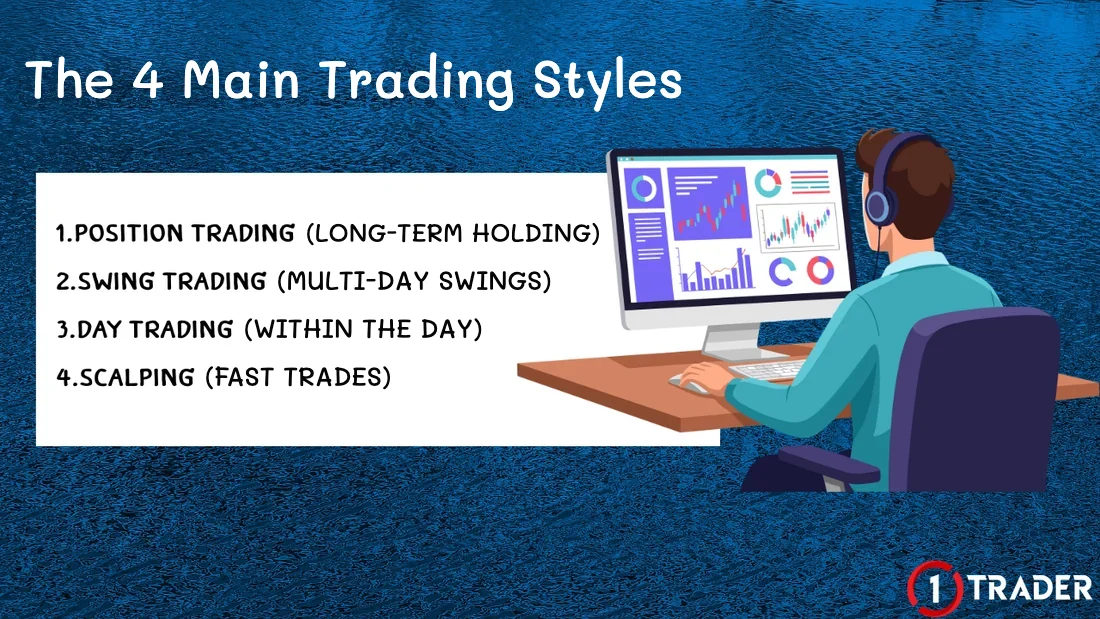
1. Position Trading (long-term holding)
These traders are similar to long-term investors, holding positions for weeks, months or even years to profit from the market’s major trends, such as gold rising steadily for many months.
Why these timeframes: Very long timeframes show the long-term trend clearly, cut out the noise of daily swings and mean you don’t have to watch the screen. Checking the chart once a day or a few times a week is enough.
Before holding a long-term gold or currency trade with your broker, check that symbol’s swap under Symbol > Specification for both long and short, and size your lot from the real stop-loss distance, as in Money Management (EP9).
2. Swing Trading (medium-term swings)
Sitting between day trading and position trading, swing trading aims to profit from medium-term price swings, holding positions from several days to 2–3 weeks.
Why these timeframes: D1 and H4 clearly show smaller trends and price patterns forming, such as a pullback to a demand zone or a Fibonacci level, while still filtering out short-term noise.
If you have a day job and are new to trading, swing trading on D1 + H4 is the most balanced place to start, because you don’t have to decide quickly and it trains you to plan before every trade.
3. Day Trading (intraday)
Day traders open and close every trade within the same day, never holding overnight, and aim to profit from intraday price swings.
Why these timeframes: H1 gives a reliable picture of the intraday trend, while M5 has enough detail to pick precise entries several times a day without being so small that noise takes over.
Set a maximum number of trades and a maximum loss per day in advance, such as 3 trades or -2% of your account, and stop trading when you hit it to avoid emotional revenge trading.
4. Scalping (quick trades)
Scalpers open and close trades very quickly to take small profits each time, holding each trade for a few seconds to a few minutes, and may trade dozens of times a day.
Why these timeframes: The goal is to profit from moves of just a few points, so you need the shortest timeframes to keep up with price changes, at the cost of high stress and a lot of noise.
Beginners shouldn’t start with scalping, because it demands a lot of discipline. If you do trade this way, use an account with a low total cost (see how to choose a broker, EP29) and avoid big news, when spreads widen.
Why smaller timeframes need to watch costs more
The spread is the same, but the profit targets differ, so the cost as a share of profit differs a lot. Compare 1 lot of gold (100 oz) with a $0.25 spread.
Profit target $1.50
Profit target $30
This doesn’t include commission and slippage, which hit scalpers hardest, while swing and position traders need to count swap instead. The numbers only illustrate the method; real costs depend on the broker and the time.
Use several timeframes for the full picture
Most professional traders don’t use a single timeframe. They use Multiple Time Frame Analysis to get both the big picture and precise entry timing.
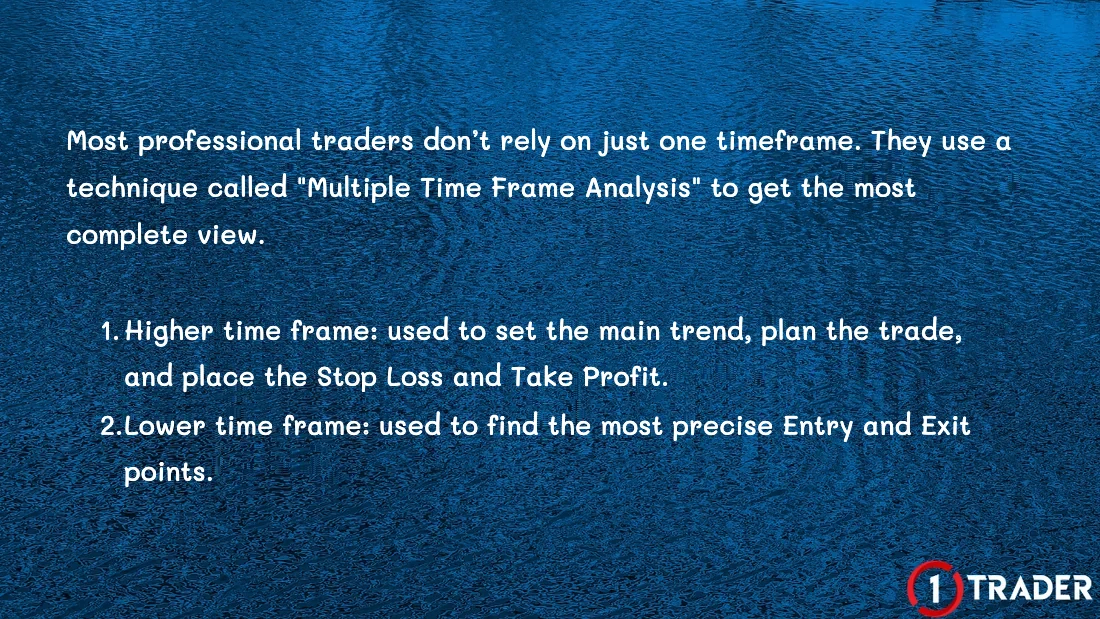
- Higher time frame
- Sets the main trend, the trading plan and the key zones, and where to place your stop loss and take profit
- Lower time frame
- Finds more precise entries and exits, for example waiting for a reversal candle or a structure break inside the zone you planned
A common guideline is for the higher timeframe to be about 4–6 times longer than the lower one, such as D1 with H4 or H1 with M15. Too close and you see the same picture twice; too far apart and the entry no longer relates to the trend. See a detailed top-down analysis in Multi-Timeframe Analysis (EP19).
How to choose your own timeframe
In the end, the “best timeframe” is the one that fits your lifestyle best. Answer these 4 questions:
| Style | Holding time | Main TF | Entry TF | Suits |
|---|---|---|---|---|
| Position | Weeks–years | W1 · MN | D1 | Very little time, lots of patience |
| Swing | Days–3 weeks | D1 | H4 | Beginners, people with day jobs |
| Day Trade | Minutes–hours, no overnight | H1 | M5 | Free during London–New York hours |
| Scalping | Seconds–minutes | M5 | M1 | Fast decisions, high discipline, low costs |
The best timeframe is the one where you can follow your plan consistently
If you have little time and dislike the pressure of fast trading, a longer timeframe such as D1 or W1 may be your best choice. Pick one timeframe pair, test it, log your trades and stick to it consistently, instead of switching timeframes to find the signal you want to see.
Frequently asked questions about choosing a timeframe
Which timeframe is best to trade?
No timeframe is best for everyone. A good timeframe fits your trading style, the time you can really spend on charts and the level of stress you can handle. Beginners with a day job usually find it easier to start with D1 and H4 charts as swing traders.
What is a timeframe?
A timeframe is the period each candlestick represents. For example, M5 is 5 minutes per candle, H1 is 1 hour and D1 is 1 day. The same price viewed on different timeframes shows a different trend and different detail.
Which timeframe should beginners start with?
Beginners should start with medium to large timeframes such as H4 and D1, because there is less noise, more time to think before entering and the spread is a small share of the profit target. Move down to smaller timeframes once you have discipline and good statistics.
Which timeframes are used for scalping?
Scalpers usually use M5 for direction and M1 for entries, holding trades for a few seconds to a few minutes. It demands intense focus, and spreads and commissions take a large share of the profit, so use a low-cost account.
Which timeframes are used for swing trading?
Swing traders usually use D1 for the trend and H4 for entries, holding trades from several days to 2–3 weeks. You don’t need to watch the screen all day, but you must account for the swap charged on overnight positions.
How far apart should the higher and lower timeframes be?
A common guideline is for the higher timeframe to be about 4–6 times longer than the lower one, such as D1 with H4 or H1 with M15. Too close and you see the same picture twice; too far apart and the entry no longer relates to the trend.
Is it OK to change timeframes often?
No. Switching timeframes to find the signal you want makes your analysis inconsistent. Choose one main and one entry timeframe, then backtest and log at least 30–50 trades before you reassess.
Read EP29 again Next lesson · EP31 What Is a Forex Rebate? How It Works and How Much It Cuts Your Costs How Trader · Broker · IB works and how to work out your net cost
Read EP31 →
See all lessons in the free Forex and gold trading course
Risk warning: Trading leveraged Forex, gold and CFDs carries a high level of risk and you may lose all the money you invest. No timeframe or trading style guarantees profits. The numbers in this article are examples for education. 1TRADER is a partner (IB) of some brokers and provides information to support your own decisions only. Read the full risk disclosure.