
What Is a Forex Rebate? How It Works and How Much It Cuts Your Costs
Cash back on the spread and commission for every lot, on winning and losing trades. Understand the Trader → Broker → IB flow, how to work out your net cost and what to check before you sign up.
Quick summary before you read
- A rebate is part of the spread and commission you pay your broker, returned to you through the IB you opened your account with
- You get it on every lot, winning or losing. Net cost = spread + commission − rebate
- It pays off most for people who trade often or in large lots, such as scalpers and day traders
- Check that the spread is the same as opening directly, that payouts are regular and verifiable, and never trade more just to earn rebates
What is a rebate in the Forex market?
In the volatile, opportunity-rich Forex market, every trader faces trading costs, mostly in the form of the spread and commission. One mechanism helps reduce that burden: the “rebate”.
Rebates are based on your trading volume (number of lots), not on profit or loss. Every time you open and close a trade, you get cash back at the agreed rate, whether the trade won or lost. If you’re not sure how spreads and commissions work, read the basics in How to choose a Forex broker (EP29) first.
How rebates work
Rebates are paid through an Introducing Broker (IB), also called a partner or affiliate, which refers clients to the broker. The broker already pays the IB a share of its spread and commission income, so the IB can pass part of it back to traders.
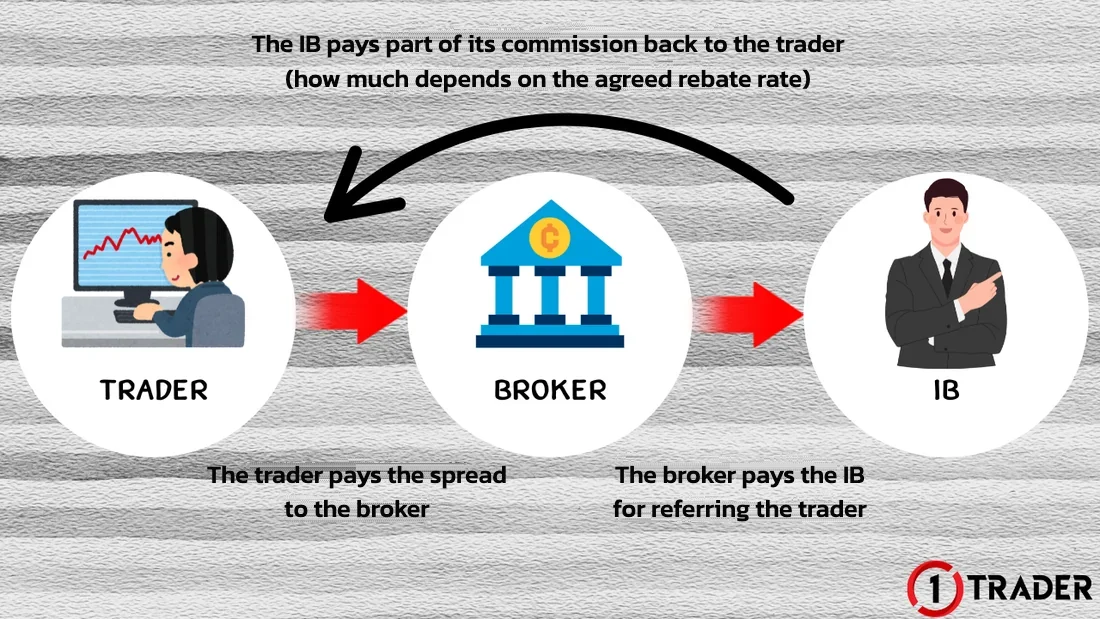
In short: a rebate is the IB giving up part of its own income to the trader. The money comes from the commission the broker already pays the IB, not from an extra charge on you. Still, make sure an account opened through the IB has the same spread and commission as opening directly.
How do rebates help traders?
The most concrete benefit is an effective reduction in your overall trading costs, especially for high-volume traders and scalpers who open and close trades often.
Cost per lot
Monthly rebates
These numbers only illustrate the method; real rebate rates vary by broker, account type and instrument. Fast traders, such as scalpers on M1–M5, see the biggest effect, because the spread takes a large share of their profit. See the reasoning in Which timeframe is best (EP30).
Checklist for choosing a rebate service
A rebate is only worth it if the IB is trustworthy and pays transparently. Check these 4 things before signing up:
An account opened through the IB must have the same spread and commission as opening with the broker directly
The % is a share of the IB commission, so compare the actual cash per lot for the instrument you trade
Check the payout schedule, the minimum withdrawal and any fees for withdrawing rebates
See lots and rebates per trade and compare them with your MT4/MT5 history
Already have a trading account? Some brokers let you move an existing account to a new IB, while others require a new account opened through the link. See the steps in how to get a rebate and compare every broker’s rates on the Forex rebate page.
Summary and cost comparison
| Case | No rebate | Rebate $10/lot | Note |
|---|---|---|---|
| Cost per lot | $25 | $15 | Same spread, cash back later |
| Winning trade, 1 lot | +$100 | +$110 | Higher net profit |
| Losing trade, 1 lot | −$100 | −$90 | Partly smaller loss |
| 20 lots a month | Cost $500 | Net cost $300 | $200 back (hypothetical) |
A rebate isn’t a strategy, but it makes every trade cheaper
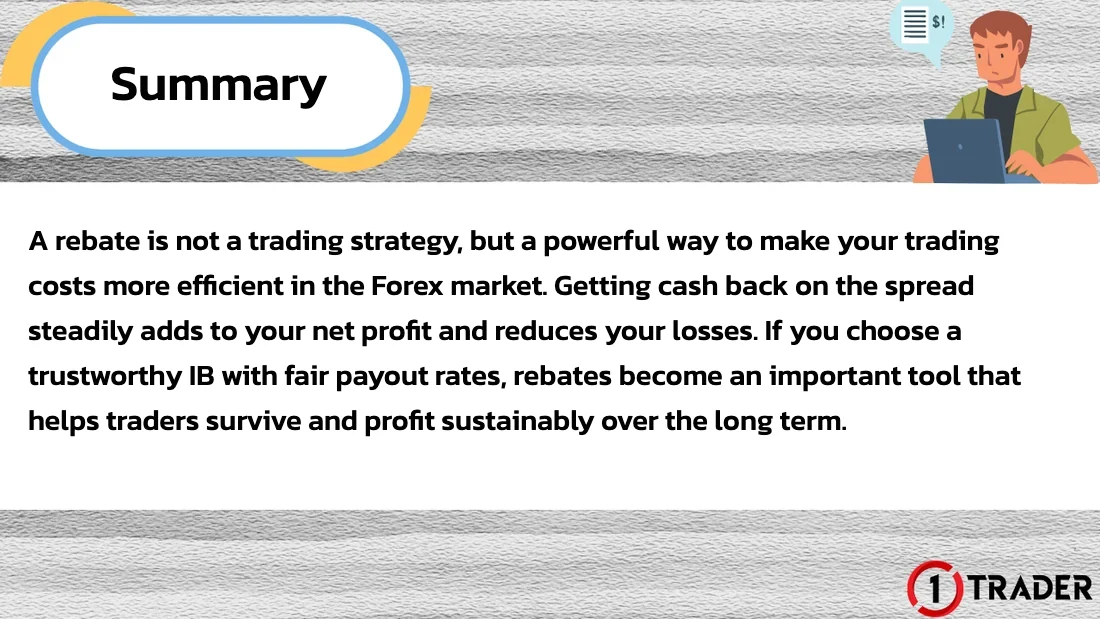
A rebate is not a trading strategy, but it is a cost efficiency that really works in the Forex market. Cash back on the spread steadily raises your net profit and reduces your losses. If you choose a trustworthy IB with fair rates and stick to your plan, rebates become a tool that helps you survive in the market over the long term, alongside risk management (EP9).
Frequently asked questions about rebates
What is a rebate?
A rebate, or cashback, is part of the spread or commission a trader pays the broker, given back to the trader. The broker pays a commission to the IB that referred the client, and the IB shares it with the trader at the agreed rate.
Where does the rebate money come from, and does it raise my trading costs?
It comes from the commission the broker already pays the IB, not from an extra fee charged to traders. Still, check that the spread and commission on an account opened through the IB are the same as on an account opened directly with the broker.
Do I get a rebate on losing trades?
Yes. Rebates are based on trading volume (number of lots), not on profit or loss, so a losing trade earns the same cash back as a winning one, which offsets part of the loss.
Who benefits most from rebates?
High-volume traders, scalpers and day traders, because they open and close trades often and pay a lot of spread in total. Rebates cut their costs far more than for someone who trades only a few times a month.
What’s the difference between a rebate in % and in $ per lot?
A percentage such as 90% or 95% is the share of the IB commission paid back, not a percentage of your deposit. $ per lot is the actual cash you get for trading 1 lot, which varies by broker, account type and instrument. Compare the $ per lot for the instruments you actually trade.
I already have a trading account. Can I still get rebates?
It depends on the broker. Some let you move an existing account to a new IB, while others require a new account opened through the IB’s link. See the steps on the how-to-get-a-rebate page.
Do rebates guarantee profits?
No. A rebate is not a trading strategy, only a cost reduction. If your trading system loses money, rebates help only partly, and you should never trade more just to earn more rebates.
Read EP30 again Next lesson · EP32 What Is MACD? How to Use It: 3 Ways to Find Entries MACD line · signal line · histogram and divergence
Read EP32 →
See all lessons in the free Forex and gold trading course
Risk warning: Trading leveraged Forex, gold and CFDs carries a high level of risk and you may lose all the money you invest. Rebates reduce costs but do not make trading profitable. Rebate rates may change with each broker’s terms. 1TRADER is a partner (IB) of some brokers and provides information to support your own decisions only. Read the full risk disclosure.